What Are Lexile Reading Levels?
Lexile measures are a scientific approach to reading assessment, developed by MetaMetrics. They help determine a student’s reading ability and the difficulty of a text, ensuring students read materials that are neither too easy nor too challenging.
How Lexile Measures Work
A Lexile score is represented as a number followed by an “L” (e.g., 850L). The scale ranges from BR (Beginning Reader) for early learners to 2000L+ for advanced texts.
- Student Lexile Measure: Assessed through standardized tests or reading programs.
- Text Lexile Measure: Evaluates sentence length and word frequency.
Matching a student’s Lexile score with appropriately leveled books promotes reading growth.
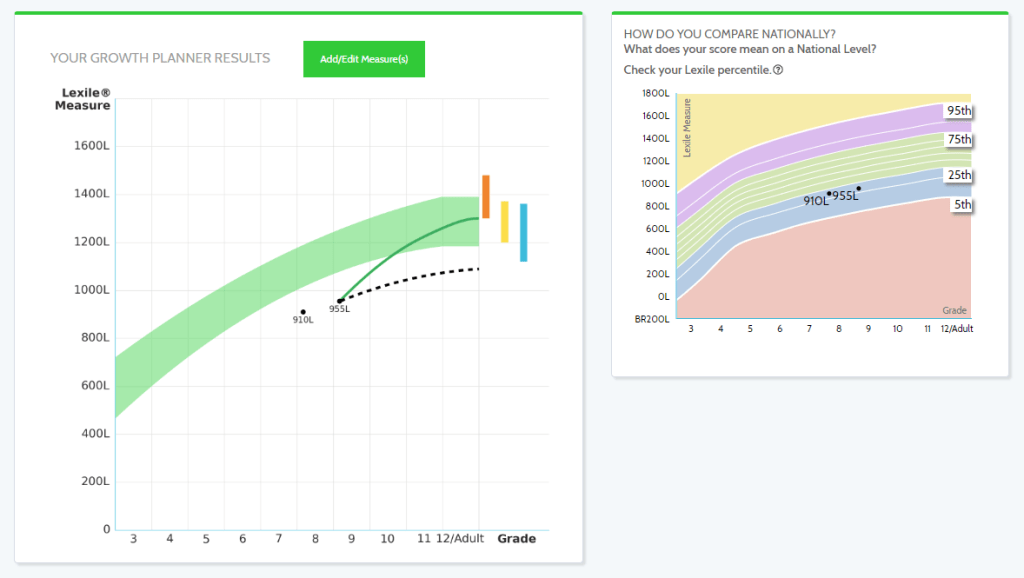
Lexile Reading Levels by Grade Chart
Below is a general Lexile range by grade level based on typical student performance.
Kindergarten to 1st Grade Lexile Levels
- Kindergarten: BR (Beginning Reader) to 230L
- 1st Grade: 190L to 530L
At this stage, students develop foundational reading skills. Books with simple sentences and high-frequency words are ideal.
2nd Grade to 3rd Grade Lexile Levels
- 2nd Grade: 420L to 650L
- 3rd Grade: 520L to 820L
Students transition from learning to read to reading to learn. Chapter books and early nonfiction texts fit within these ranges.
4th Grade to 5th Grade Lexile Levels
- 4th Grade: 740L to 940L
- 5th Grade: 830L to 1010L
Reading becomes more complex, with longer sentences and advanced vocabulary. Historical fiction and STEM-related books are great choices.
6th Grade to 8th Grade Lexile Levels
- 6th Grade: 925L to 1070L
- 7th Grade: 970L to 1120L
- 8th Grade: 1010L to 1185L
Middle school students engage with more sophisticated texts, including classic literature and technical materials.
High School Lexile Levels (9th–12th Grade)
- 9th–10th Grade: 1050L to 1260L
- 11th–12th Grade: 1185L to 1385L
High schoolers should read college and career-level texts, including research papers and advanced literature.
How to Use Lexile Levels Effectively
Finding Books Within a Student’s Lexile Range
Use the Lexile Find a Book tool (available on the Lexile website) to search for titles within a student’s reading level chart.
Balancing Challenge and Comfort
Aim for books within a student’s Lexile range, but also consider:
- Interest level (a high school student may not enjoy a book written for younger readers, even if the Lexile matches).
- Background knowledge (complex topics may require additional support).
Encouraging Growth
Gradually introduce books at the higher end of a student’s Lexile range to build stamina and comprehension.
Benefits of Using Lexile Measures
- Personalized Learning: Helps tailor reading materials to individual needs.
- Progress Tracking: Measures reading growth over time.
- College & Career Readiness: Prepares students for advanced texts.
Limitations of Lexile Measures
While Lexile levels are useful, they don’t account for:
- Text content (a book may have a low Lexile but mature themes).
- Reader engagement (motivation plays a key role in comprehension).
Final Thoughts
The Lexile Reading Levels by Grade Chart serves as a helpful benchmark for selecting appropriate books. By pairing students with texts that match their reading ability, educators and parents can foster a love for reading while promoting literacy development.
For more precise recommendations, consult your child’s teacher or use Lexile tools to explore book options. Happy reading!
 Lexile Reading Levels by Grade Chart